Trauma: Whenever I inadvertently ate something with a mouldy taste or smell, I’d have something that looked like an allergic reaction; but the reation was not actually allergic, there was no (imminent) physical issue
Core wound: I am unseen, unheard, because I am unworthy of love, unworthy of being cared for
For as long as I remember, I have had pretty ‘violent’ or ‘abrupt’ reactions to tasting (or smelling) mouldy food. I’d spit out the food. Immediately.
I had a really elaborate ‘story’ to go with it; explaining in intellectual detail what it was, how I reacted, and how I counter-acted, including the “I’m not allergic to it, but my reaction is really strong; there’s a hair trigger. I just don’t understand it”.
The more I discover about my complex trauma (CPTSD), the more I realise that most, if not all, of my triggers are emotional in nature.
Except for this one. And I have only discovered this trigger, and probably ‘solved’ getting triggered by it this year. Decades after it was created. I knew there was something, but I always approached it intellectually (I wouldn’t have known how to it any other way, even if I was pressed for it); never from an emotional source.
I posted a video on Tiktok about it about six months ago; showing a portion of fresh 5 formaggi pasta (and the “operative cheese” being Gorgonzola), with the following text:
This looks innocuous right? A portion of fresh 5 formaggi pasta.
One of the 5 cheeses used is Gorgonzola. that cheese has always given me a very strong trigger.
I very much understood the “what” of happened when I’d get triggered. Even just the smell triggered me.
And to be clear, it was never about the cheese, but the mould in it. I’d be able to taste in the nearest slice of a lof of bread, that in the furthest slice, at the other end of the loaf, mould was developing. That’s how hypervigilant I had become.
I had to get whatever it was out of my mouth, and I could not eat the remainder.
I never understood the “why”, and I still don’t. But a few weeks ago, I unknowingly bought one of these, and prepared it, and still didn’t realise this would be problematic. And no, this was not a case of “I only have the allergic-like reaction if I know what I’m eating”. I ate it, without that trigger taking place. I certainly noticed the taste of the cheese, and was a bit “meh, I don’t really like the flavour, but I don’t dislike it either. Previously I’d have spit it out”, and I simply continued eating the rest of the portion.
One day, I might be able to discover the “why”. For now I am really grateful to be triggered much less. I don’t think I’ll go and buy a block of bleu cheese anytime soon, but….
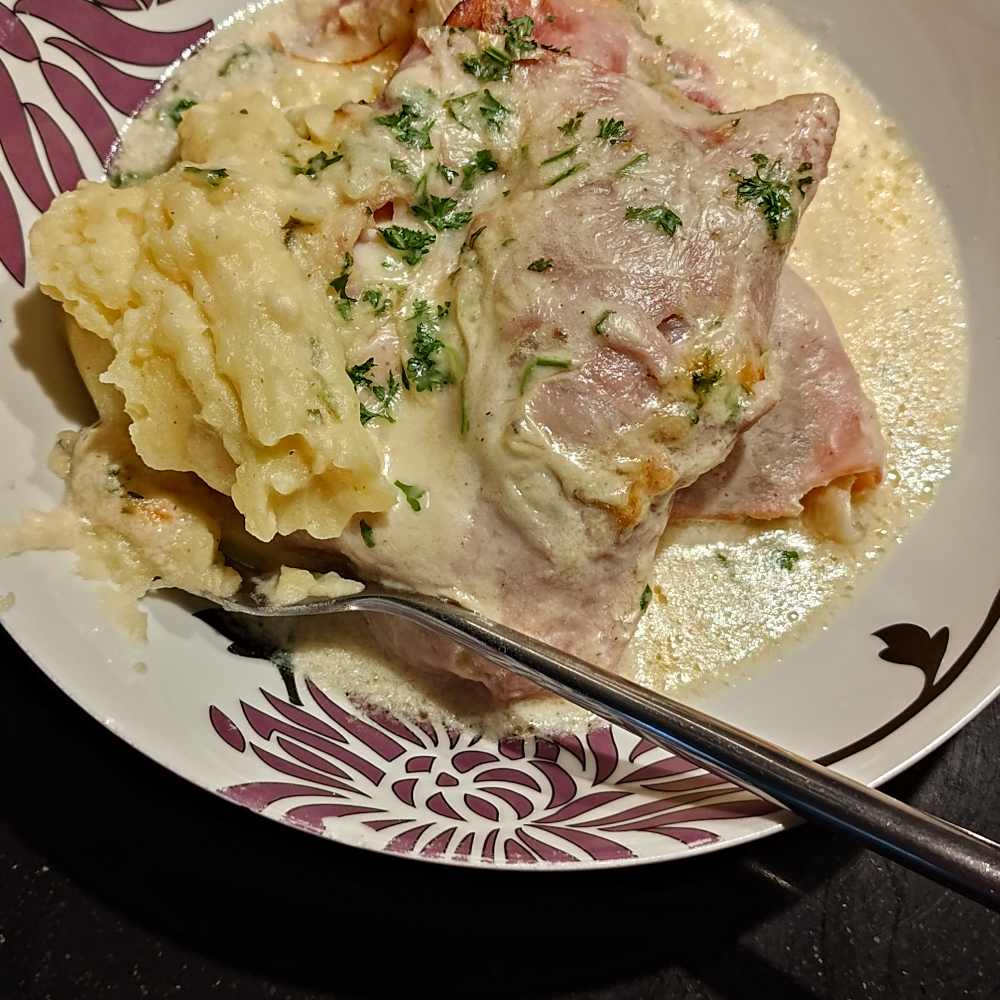
And now I think I finally understand what it was about, what the “why” was; as I had Belgian endive the other day; a vegetable that is adjacent in taste and flavour; bitter. Not quite the kind of bitter that is connected to mouldy food, but near enough to trigger me. And again, I didn’t trigger, I had actually fully consciously bought this oven-ready meal; Belgian endive with cheese and mashed potato. I enjoyed eating it.
Shortly after the ‘5 formaggi’ revelation, I had asked my mother about bitter/mouldy food or flavours, if she ever noticed something with regards to me reacting to eating/smelling any of that, but she couldn’t enlighten me. She didn’t recall anything in particular, but offered that perhaps it was simply that we grew up on welfare, and food insecurity was a thing in our household, and that perhaps food sometimes had aready started getting mouldy but we couldn’t afford tossing it, so we ate it just the same. It sounds plausible enough. And terrible enough. How can you allow (coerce?) your children to eat moulded food?!?!? Food insecurity or not!
It doesn’t feel like that in itself was enough for it becoming a traumatic experience that would cause me to get severe trigger reactions for decades to come.
Part of my growing up was that I felt very “unseen and unheard”, which solidified in “I’m unworthy (of love/attention), I am not good enough, I am broken, I’ll be betrayed and abandoned”, and a recurring situation while growing up was the hours-long talks with my mother.
These were invariably initiated by her; never by me. Or at least, I can’t remember any that I started. If I ever wanted to talk with her about something that was on my mind, or something I “felt”; I only recall those invalidating “Not now, I’m busy” words. Every. Time. That’s a perfect way for a young child to feel unseen and unheard, and unworthy, and just stop asking to talk to share; lest they’d hear those same words of rejection. Again. Just swallow whatever is on your heart/mind; it’ll stop hurting soon enough.
These talks she’d have with me would be either about her and her trials and tribulations as a single mother (cue: parentification), her talking about my father and the effect his leaving obviously had on me (cue: parental alienation), or simply about me; or more precisely “her opinion/thoughts about me”.
The first two are potentially – each on their own – already deeply traumatising to a young child. That third one just compounded the already traumatised situation I had been manoeuvred in. And I was utterly unable to get away from it. My father had already left me. Was I – a young child – going to stand up to my mother, tell her “No! Stop! You’re hurting me!” and see her leave me too? I’d be helpless, not able to provide for myself. That’d be like me signing my own death sentence. And that’s where and how the “were you in danger of dying?” checklist item for seeing if any of the “approved” causes for a PTSD diagnosis can be verified.
I now clearly recognise how the complex trauma manifested itself in me and my behaviour; I had gotten stuck in a freeze response, but masked it with a fawn response; while intellectualising everything. Everything. No wonder it took me decades to discover, let alone, unravel the mess that was caused.
And my mother knew all along, because many of the talks we had about me were about exactly that; she clearly saw all of the symptoms, she noticed I had become increasingly isolated, apathetic, sombre, dejected, dissociated, annoyingly cerebral (think: “know-it-all”), lost my spark and my spontaneity, and had started becoming a people-pleaser. Rather than trying to look for a solution with me, seeing if she could help lighten the burden I was carrying, or trying to find outside help for me, she simply pointed to my father having left me being the inevitable cause for it, while she also reprimanded me for my changed behaviour. She never “just observed”; she judged. And I think that is how she managed to shift to how that affected her – centering herself, and de-centering me – only further cementing the already damaging influence these talks had.
That last type to talks we had one feels more and more uncomfortable the more I realise the dynamic that surrounded those talks; she’d tell me about me and my behaviour, and if I reacted to that with in an emotional manner, she’d tell me off; the way she directed the way these talks took place, it was like she and I had a therapist-to-therapist talk about “the patient” (little me).
And now imagine that these talks she had with me weren’t just when I was nearly adult, but they started around age six/seven, when I first started showing unmistakeable signs of trauma, and these talks continued throughout my childhood and adolescence, until I left home to study, when I was 20. My trauma travelled with me.
I’ll get back on track now.
So, where do mouldy food and bitter tastes come in to play? That’s what I started writing about. Rather than trying to explain the intricate way trauma makes a person to trigger to seemingly unrelated things, people, feelings, I’ll share this TikTok video, does an excellent job (visually) explaining it than I can.
Many of these talks happened at the dinner table (and then moved to the living room, post meal). It makes total sense to me that this combination of emotionally stressful talks while (regularly?) tasting mouldy food caused this trigger to take shape.
The more I realise how my mother was ‘in the room’ constantly as she traumatised me (I must leave in the option of “unknowingly” here, but with such a keen sense of observation, how she could, on the one hand be very aware of the change in my character and behaviour, yet be completely oblivious to her part in it. She can’t just offload that to responbility to my father. But she did. And still does. Some momths ago, I explicitly asked her about her role in this as I grew up while my father was still with us. After he left; the direct effect he had could only shrink, while she remained the one constant factor in my life.
I obviously can’t diagnose my mother, but the more I read and learn about childhood trauma and the nervous system, I’m thinking of any, or a combination, of covert narcissism, being an emotionally immature parent, and passing on generational trauma to me, rather than processing hers.
And the more I realise that, the more I am starting to feel the one emotion I have always feared expressing, and avoided doing so like the plague. It felt like expressing that as a child; it would result in instant abandonment, rejection, suffering, akin to death – but it is probably also exactly the emotion that could have saved me, had it not been for the fact that my mother reprimanded me for showing *any* (but especially this one) emotion during her talks with me, so instead, I started pleasing her and swallowing my emotions, lest she’d reprimand me more; causing exactly what I’d been trying to avoid at all costs…
Anger.
What on earth were you thinking that I would get through this unharmed?!?!
What on earth were you thinking that you had no part in hurting me?!?!